
During a move, the glass of furniture, frames, or glass doors is among the most vulnerable elements to breakage. Applying cross tape on a glass surface is a common reflex, passed down from generation to generation. The problem: this action, taken in isolation, does not protect as much as one might think, and can even worsen the situation if the rest of the packing protocol is neglected.
What glass manufacturers really say about tape on glass
Saint-Gobain Glass, in its 2023 transport and handling guide for glass, specifies that adhesive tape applied to a pane does not prevent breakage. Tape does not reinforce the glass: it can at most partially hold shards if the glass breaks.
The downside is less known. The shards held by the adhesive tape create a trap when removing it: the person who takes off the tape after transport can injure themselves on fragments held under tension. Additionally, there are micro-scratches left by certain adhesives and glue residues, which can be very difficult to remove from treated or tinted glass.
This observation does not mean that tape is useless. It means that tape alone does not provide sufficient protection. Using it as the only measure confuses a visual signal (“caution, fragile”) with a true physical barrier against shocks. To protect a pane with tape effectively, this action must be integrated into a complete packing protocol.

Adhesive tape for glass: not all tapes are created equal
The choice of tape radically changes the outcome. A standard packing tape (brown or clear polypropylene) adheres strongly to glass and leaves stubborn sticky marks after a few hours of exposure to heat, typical of a moving truck in summer.
Since 2022-2023, brands like 3M and Tesa offer low-tack masking tapes designed for glass surfaces. These products, often labeled “facade,” “outdoor,” or “window masking,” can be removed cleanly within seven to fourteen days without tearing the paint from the frames or leaving residues on the glass.
Criteria for selecting tape
- Adhesion: prefer a low-tack tape specifically tested for glass, rather than a standard packing adhesive
- Duration of application: check the packaging for the maximum duration of use without residues (glass masking tapes generally indicate between seven and fourteen days)
- Width: a five-centimeter tape covers diagonals better than a thin two-centimeter tape, and distributes pressure more evenly in case of impact
The additional cost of a suitable masking roll remains modest compared to the price of replacing a pane or professional cleaning of adhesive residues.
Complete glass protection protocol for a move
Tape plays a role in the protection chain, but it is only one link. Specialized insurers, notably MAIF in its practical moving insurance guide (2024 edition), require adherence to professional protocols. A simple cross tape on the glass can reduce compensation if no other physical protection has been put in place.
Steps in order
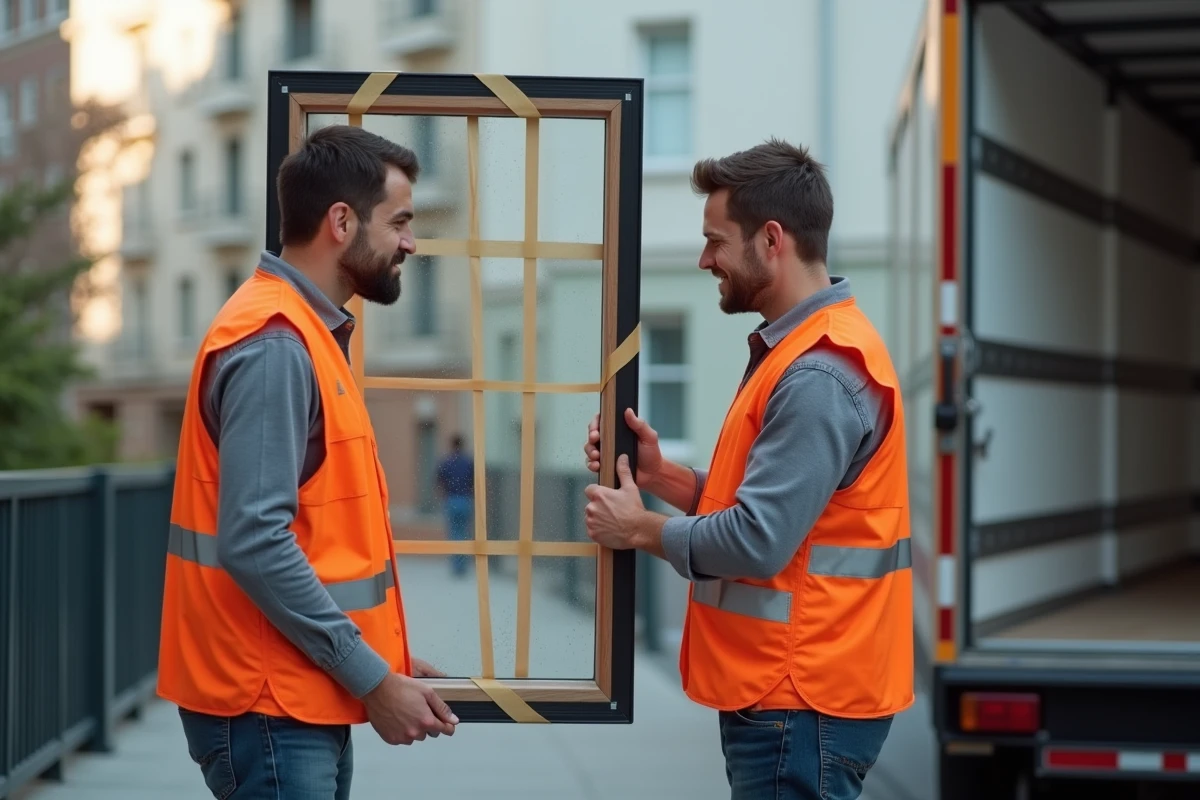
Start by cleaning the glass surface so that the tape adheres properly. Then apply the masking tape in crossed diagonals (forming an X) along the edge of the frame. This mesh holds the fragments in case of cracking during transport.
Next, apply a layer of physical protection directly on the glass: foam board, custom-cut expanded foam, or, if not available, several layers of bubble wrap. Secure this layer with adhesive tape around the frame, without sticking directly to the unprotected glass.
- For glass furniture (bookshelves, buffets): remove the glass if it is removable and pack it separately between two rigid cardboard sheets, secured vertically in the truck
- For mirrors and frames: wrap in a moving blanket after the cardboard layer, then secure with tape to keep everything compact
- For non-removable glass doors: place foam corner protectors on all four corners and secure the furniture upright, never flat, to limit glass bending under its own weight
Removing tape after the move: mistakes that damage glass
The removal phase is one that most guides overlook. Leaving standard adhesive tape on a pane for more than a few hours, especially if the glass has been exposed to heat, turns a protective action into a source of damage. The adhesive polymerizes under heat and becomes nearly impossible to remove without solvent.
For already applied standard tapes, a cloth soaked in isopropyl alcohol or vegetable oil softens the residues without scratching the surface. Metal scrapers should be avoided on treated glass or laminated glass, as they can damage the surface coating.
Low-tack masking tapes avoid this problem as long as the application duration indicated by the manufacturer is respected. A move that spans several days, with intermediate storage in a storage unit, can exceed this limit. In this case, removing the tape before storage and reapplying it at the time of final loading remains the safest method.
Glass and moving insurance: what the contract really covers
The question of insurance coverage should be raised before moving day. Field reports vary on this point: some insurers consider that a taped pane without additional protection does not comply with “best practices,” which can justify a reduction in compensation.
Keeping dated photos of the packaging of each glass item is a simple precaution. In case of breakage, these images serve as proof that the protection protocol was correctly applied, with tape, foam, or cardboard, and appropriate securing in the vehicle.
Tape on a pane remains a useful gesture, provided it is seen as the first layer of a multi-layered packing approach. Used alone, it visually reassures without providing significant mechanical resistance. Combined with rigid protection and vertical securing in the truck, it truly limits the dispersion of shards and facilitates the management of any potential breakage.