
Calculating the volume of a pyramid with a triangular base relies on a short formula, but its application often encounters a specific obstacle: determining the area of the base when only the lengths of the three sides of the triangle are known. The general formula (base area multiplied by height, divided by three) is not difficult in itself. The trap lies upstream, in calculating this base area.
Heron’s Formula: The Necessary Step When the Height of the Triangle is Missing
Most educational resources present the volume formula assuming that the base area is already known. In a school exercise or a real technical problem, this is not always the case. It frequently happens that the statement provides only the three sides of the base triangle, without specifying its height.
This is where Heron’s formula comes into play. It allows you to calculate the area of a triangle from its three sides, without needing to draw or measure a height. The process is broken down into two steps.
- Calculate the semi-perimeter of the triangle: add the three sides and then divide by two. We denote this result as s (for semi-perimeter).
- Apply the formula: the area of the triangle is equal to the square root of s multiplied by (s minus the first side), (s minus the second side), and (s minus the third side).
- Substitute this area into the volume formula: V = (Base Area x Height of the Pyramid) / 3.
This detour through Heron avoids the dead end that many students encounter when trying to identify the height of the base triangle on a perspective diagram. The calculation of the volume of a pyramid with a triangular base then becomes a succession of arithmetic operations, without any additional geometric construction.

Pyramid with a Triangular Base and Tetrahedron: A Distinction That Changes the Reasoning
Every pyramid with a triangular base has four triangular faces, but not all are regular tetrahedra. A regular tetrahedron is the special case where all four faces are identical equilateral triangles. This distinction is not just a vocabulary point.
When the pyramid is a regular tetrahedron, the height can be directly derived from the length of the edge by a fixed relationship. The volume formula then simplifies to an expression that depends only on the edge. In contrast, for an irregular triangular base pyramid, it is necessary to separately identify the base area and the perpendicular height connecting the apex to the base plane.
Confusing the two cases leads to significant errors. A regular tetrahedron offers a shortcut for calculations, but applying this shortcut to an irregular pyramid skews the result. Before choosing a method, checking whether the four faces are identical or not is a preliminary step that is too often overlooked.
Identifying the Height of the Pyramid Unambiguously
The height of a pyramid is the perpendicular distance between the apex and the plane that contains the base. In a perspective diagram, this height almost never corresponds to a visible lateral edge. This is the most common source of error in exam papers.
To eliminate doubt, two simple checks help:
- The height forms a right angle with the base plane. If the statement specifies that the foot of the height is the center of the base, the pyramid is straight. Otherwise, it is oblique, and the foot of the height may fall outside the base triangle.
- The height is never the apothem of a lateral face. The apothem connects the apex to the midpoint of a side of the base through a face, not through the interior of the solid. Confusing height and apothem means using a measurement shorter or longer than the true height.
- If only the edges are given, the height must be reconstructed using the Pythagorean theorem applied in the correct right triangle, the one formed by the height, the distance from the foot of the height to the apex of the base, and the corresponding lateral edge.
Applying the Volume Formula Step by Step
The formula remains the same regardless of the shape of the triangular base: V = (base area x height) / 3. The factor of one-third comes from the constant ratio between the volume of a pyramid and that of the prism that encloses it (same base, same height). Three identical pyramids exactly fill a prism, hence the division by three.
Case of a Right Triangle Base
When the base triangle is right-angled, the area is calculated directly: the product of the two sides of the right angle divided by two. This is the simplest case. Substituting this area into the volume formula requires no intermediate steps.
Case of a Triangle Base with Known Base and Height
If the statement provides one side of the triangle and the height relative to that side, the area is half the product of the two. The volume follows immediately.
Case of a Base Defined by Three Sides Only
This is the tricky case. Without the height of the triangle, Heron’s formula becomes the only practical option. First calculate the semi-perimeter, then the area, then the volume. Three successive calculations, none of which can be skipped.
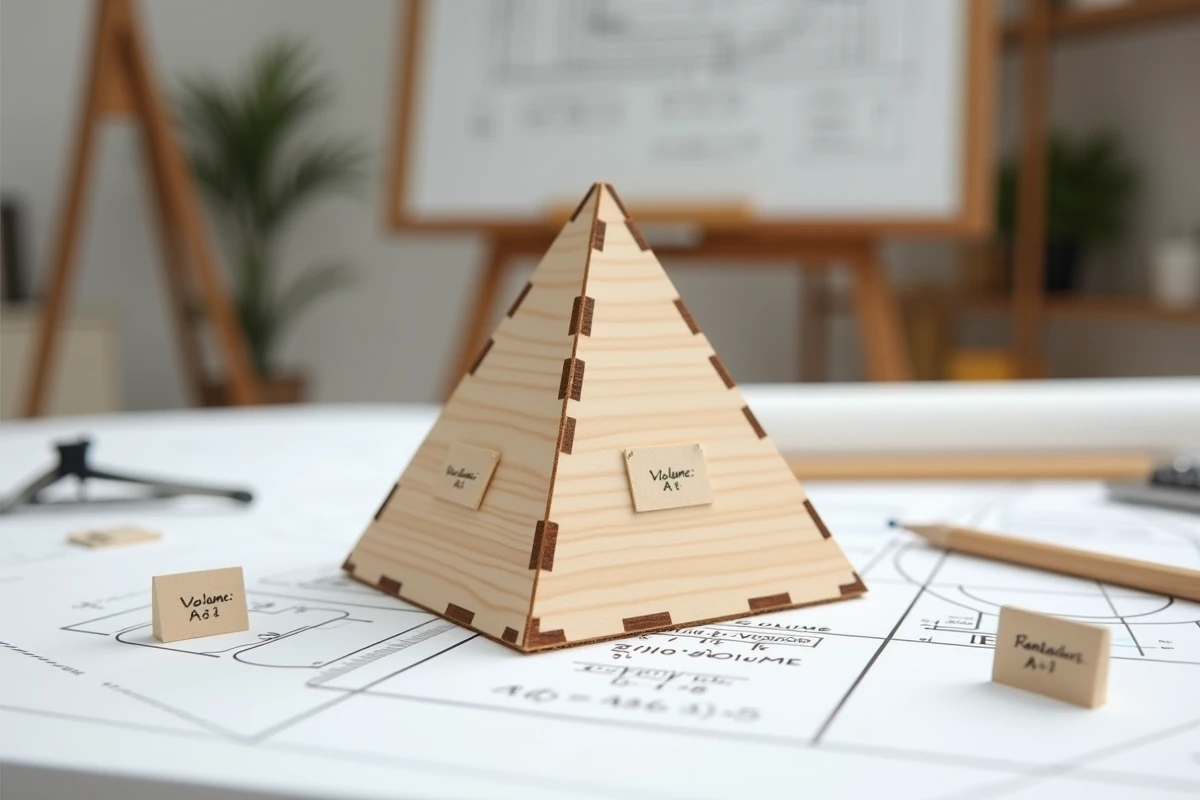
Common Errors in Calculating the Volume of a Triangular Pyramid
Forgetting to divide by three is the most cited error, but it is not the most frequent in practice. The confusion between the height of the pyramid and the height of the base triangle causes more erroneous results. These two heights are perpendicular to each other and have no direct numerical relationship.
Another trap: using the area of a lateral face instead of the area of the base. In a pyramid with a triangular base, all four faces are triangles. Nothing in the drawing visually indicates which one is the base. The statement specifies it, but a flipped or misoriented diagram can easily mislead.
Checking the consistency of the result helps to spot these mistakes. The volume of a pyramid is always less than one-third of the volume of the rectangular parallelepiped that would encompass the solid. If the result exceeds this limit, one of the measurements has been misidentified.
The calculation of the volume of a pyramid with a triangular base boils down to one formula, but its reliability entirely depends on the rigor applied to the preliminary steps. Identifying the correct base, measuring the correct height, choosing the right method for the area of the triangle: this is where the precision of the result lies, not in the formula itself.