
A visible hallmark is no longer sufficient to guarantee the authenticity of an antique silver cutlery piece. Since 2023, counterfeits of French and British hallmarks have been multiplying on online marketplaces, with imitations of the Minerva struck on simply plated metal. Proper authentication before any transfer requires cross-referencing several material indicators, not just flipping the piece to look for a mark.
Portable XRF Spectrometry and Limitations of Acid Testing on Antique Cutlery
The royal water or nitric acid test remains the most common reflex among individuals. On an antique cutlery piece, it poses two concrete problems: it attacks the surface (scratches, micro-craters) and only provides information about the superficial layer. A thick silver-plated metal will react similarly to solid silver in the first seconds of the test.
Portable XRF spectrometry has established itself as the standard among auctioneers and assay offices since the early 2020s. The XRF gun bombards the surface with X-rays and returns the complete elemental composition—copper, zinc, silver, nickel—in a few seconds, without destructive contact. We recommend this analysis as soon as the hallmark is worn, partially erased, or suspicious.
A technical point often overlooked: XRF measures a limited depth of material. On a cutlery piece with a brass core covered by a thick layer of silver, the reading may overestimate the purity if the operator does not properly calibrate the device. Ask the professional if they use a “multi-layer” mode suitable for plated objects, as the distinction between 925 sterling silver and silver-plated metal relies on this calibration.
To verify hallmarks before a purchase, we often direct to the detailed sheets on Christofle silver cutlery on French Home, which illustrate the main marks of silversmiths and French guarantee hallmarks.
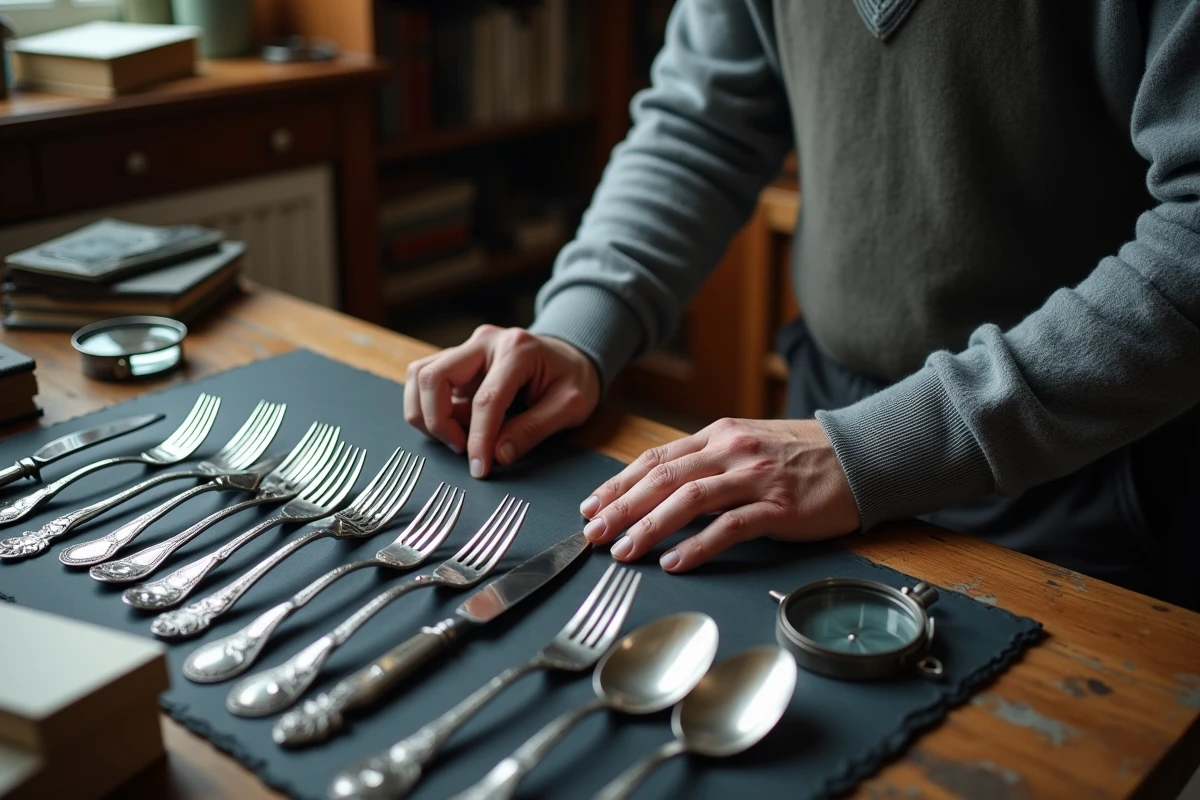
French Hallmarks on Antique Cutlery: Reading Beyond the Minerva
The Minerva head, the most well-known guarantee hallmark, indicates a purity of 800 or 950 parts per thousand depending on the format of the cartouche (small or large module). The presence of this hallmark alone does not provide any information about the period, the silversmith, or the market value of the cutlery piece.
Three other hallmarks should be systematically sought:
- The master silversmith’s hallmark, a diamond shape enclosing the initials and a figurative symbol. It identifies the manufacturing workshop. A piece signed by a recognized master (Puiforcat, Cardeilhac, Ercuis) has a higher value than an anonymous piece of the same purity.
- The large guarantee or census hallmark, sometimes struck during a change of tax regime. Its presence on an 18th-century piece confirms an ancient circulation and reinforces authenticity.
- The community hallmark (before 1797) or departmental assay office hallmark (after 1797), which geographically locates the piece. Cutlery bearing a rare provincial hallmark is sought after by specialized collectors.
We observe that counterfeit hallmarks almost always imitate only the Minerva, without reproducing the master diamond or the assay office hallmark. A piece bearing only a Minerva, without any other hallmark, should raise suspicion.
Consistency Between Hallmark, Style, and Wear
An authentic hallmark does not guarantee that the cutlery is intact. Check for consistency between the decorative style (gilding, shells, rococo) and the presumed period of the hallmark. An Art Deco design on a piece bearing a hallmark from the Ancien Régime is a disqualifying inconsistency.
The natural wear of a piece used for over a century leaves characteristic traces: regular thinning of knife edges, homogeneous gray patina, multidirectional micro-scratches. An uniformly shiny surface or a chemically applied patina (sulfur blackening) indicates recent treatment, sometimes intended to mask re-plating.
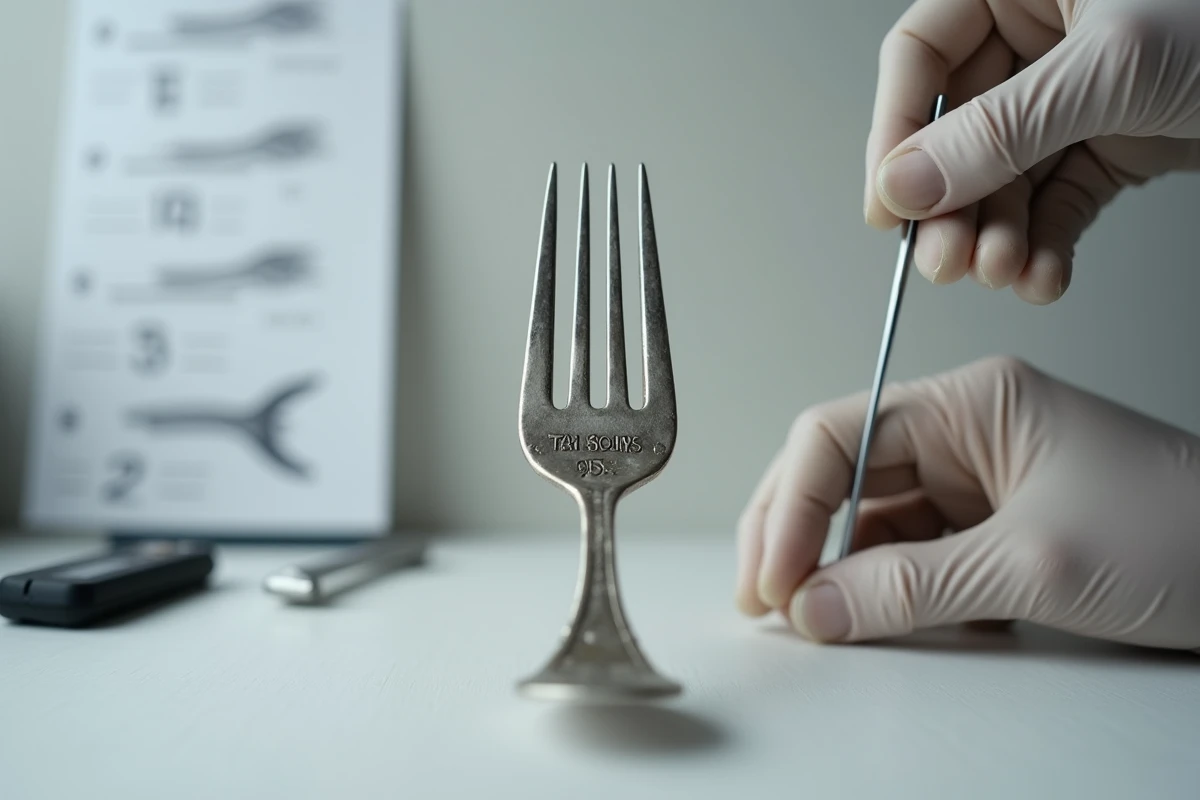
Solid Silver, Silver-Plated Metal, Vermeil: Distinguishing Alloys Before Sale
The most common confusion concerns silver-plated metal, often stamped with misleading mentions. The inscriptions “84 g” or “100 g” engraved on some cutlery do not refer to a weight of silver: they indicate the weight of the silver layer deposited by electroplating on a dozen pieces. A piece marked “84 g” is silver-plated metal, not solid silver.
Vermeil, sometimes confused with gold-plated silver, must meet a precise definition: layer of gold of at least a few microns on a solid silver support. A genuine vermeil piece bears both a silver hallmark and a gilding indication. Its value exceeds that of bare solid silver, provided that the gilding is original and not redone.
Weighing and Magnetic Testing: Two Quick Checks
Before any in-depth expertise, two simple actions eliminate some doubts:
- Comparative weighing: a solid silver piece is significantly heavier than a silver-plated piece of the same model, as the core alloy of the latter is less dense.
- Magnetic testing: silver is not ferromagnetic. If a powerful magnet (neodymium) adheres to the cutlery, the support contains nickel or steel, which excludes solid silver.
- The sound: a solid silver piece produces a clear and prolonged ringing when struck lightly. Silver-plated metal sounds duller and shorter.
These tests do not replace XRF analysis, but they allow for quick sorting of a lot before consulting a professional. A piece that fails the magnetic test or whose weight seems abnormally low does not justify the cost of a thorough expertise.
The resale value of an antique silver cutlery piece depends on the purity, the net weight of fine silver, the signature of the silversmith, and the condition of the hallmark. A complete lot with a legible master hallmark trades at a completely different level than a mismatched assortment with an erased hallmark. Having these elements verified before setting a price avoids underestimating a quality service or, conversely, overvaluing silver-plated metal taken for solid.