The spring-summer 2026 fashion trends converge towards a precise concept: curated fashion, a streamlined wardrobe where each piece works with the others. In a shopping space that brings together various styles, this approach raises a concrete question. Which pieces truly transcend seasons and wardrobes, and which fall under a trend too brief to justify the purchase?
Transversal pieces versus short-lived trends: a sorting grid for sustainable purchasing
Curated fashion is based on a measurable principle: fewer pieces, but chosen to work together. Not all trends displayed in the window deserve the same investment. Some last through several seasons, while others disappear in a few months.
The most reliable criterion for distinguishing between the two remains the color palette. Natural shades like sand, terracotta, deep blue, and sage green return season after season. They combine effortlessly with each other. In contrast, a very saturated or specific color (butter yellow, for example, highlighted this season) has a shorter stylistic lifespan.
| Criterion | Transversal Piece | Short-lived Trend |
|---|---|---|
| Palette | Natural shades (sand, terracotta, deep blue, sage green) | Very marked unique color (butter yellow, bright pink) |
| Cut | Soft cuts, slightly defined shoulders | Extreme volume or very structured silhouette |
| Detail | Subtle draping, discreet asymmetry | Very identifiable print for one season |
| Combinability | Can be worn with at least three other pieces from the wardrobe | Requires specific accessories or pieces |
This table does not classify pieces as “good” or “bad.” It allows for informed decision-making: a short-lived piece can be justified if the budget allows and if the pleasure of wearing it is real.
Several styles coexist in the DLG Fashion shopping space, which facilitates this type of sorting since durable pieces and seasonal items are visible side by side.

Spring-summer 2026 silhouettes: the high-low contrast as a guiding thread
The 2026 season is structured around a contrast between voluminous bottoms and fitted tops. This silhouette principle is not new this year, but the way it is interpreted is evolving.
The tops favor a second-skin effect, asymmetric cuts, or minimalist tops. Volume shifts downward: wide trousers, flowing skirts, loose bermudas. This distribution creates a clear visual line without resorting to complex pieces.
Why this contrast works for all styles
A minimalist wardrobe can adopt it with a solid top and soft linen trousers. A more expressive wardrobe will play with a colorful asymmetric top and a draped long skirt. The rule remains the same: only one point of volume per outfit.
Slightly defined shoulders also return in jackets and blousons. This detail structures the silhouette without adding bulk, unlike very pronounced shoulders which are more indicative of a short cycle.
Sustainable colors and seasonal palette: what fashion trends reveal
The spring-summer 2026 palette confirms a shift towards reusable natural shades from one season to the next. Sand, terracotta, deep blue, and sage green form a stable chromatic foundation.
These colors share a technical characteristic: they work in monochrome. A terracotta pant can be worn with a sand top or a sage green blazer without creating a visual break. This interchangeability is the hallmark of a transversal palette.
Seasonal palette: the trap of the “star” color
Each season highlights a key color, often heavily promoted on social media and fashion blogs. The problem is not the color itself, but the quantity of pieces purchased in that unique shade.
- One piece in the seasonal color (a scarf, a top) is enough to refresh an existing wardrobe without creating textile waste come fall.
- Natural colors withstand repetition: wearing sand or deep blue several times a week goes unnoticed, unlike a very bright hue.
- The cost per use of a piece in a durable color is mechanically lower, as it remains wearable the following season.

Adapting curated fashion to a multi-style shopping space
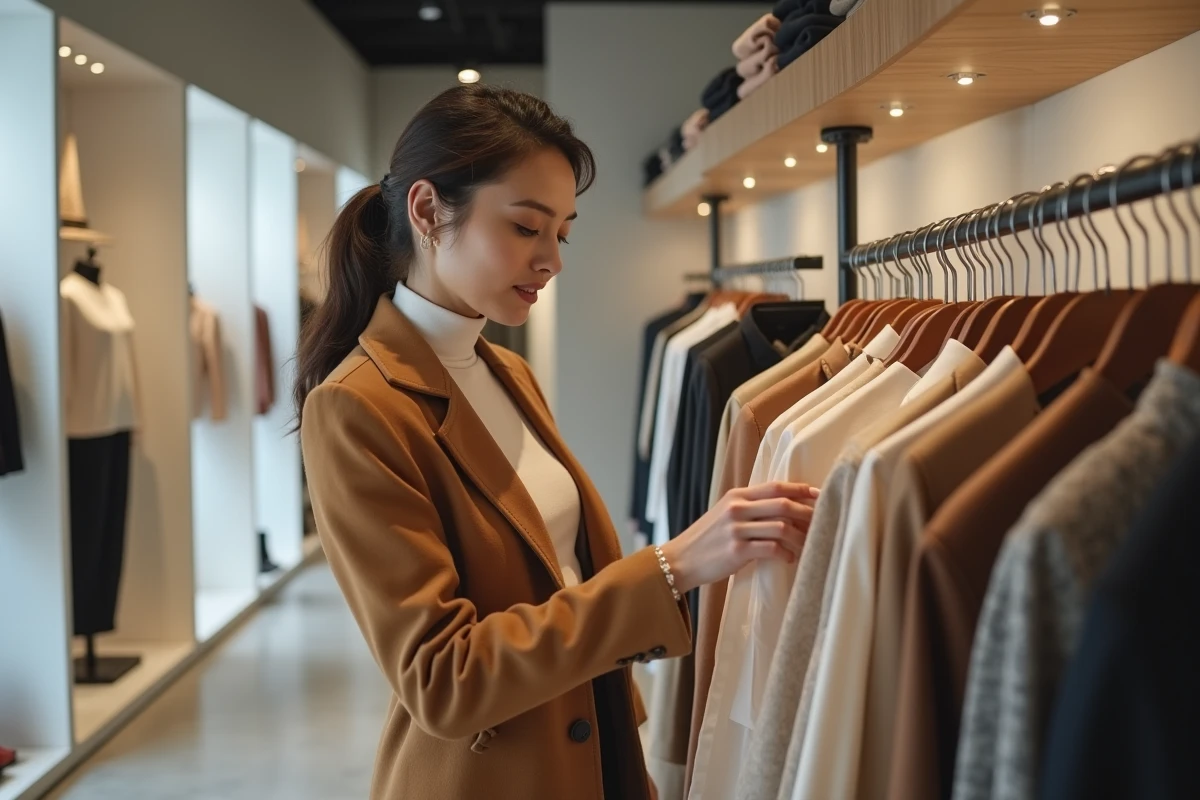
A shopping space that brings together multiple brands and styles offers a concrete advantage for applying curated fashion: the ability to compare pieces against each other before purchasing.
The reflex to adopt is to mentally test each piece against three existing outfits. If the piece only works with one combination, it likely falls under an impulse buy rather than a strategic addition to the wardrobe.
Subtle draping and discreet asymmetry, two recurring details this season, illustrate this logic well. An asymmetric top in a neutral shade fits into a casual, professional, or dressed-up wardrobe. The same top in a very identifiable print limits the possibilities.
Curated fashion does not require giving up pleasure or novelty. It simply proposes a filter: each added piece should enhance the existing wardrobe, not complicate it. In a shopping space where styles coexist, this filter becomes a navigation tool among the offerings, not a constraint.
The true test of a so-called “must-have” fashion trend remains its ability to survive beyond the season that launched it. Pieces in natural colors, soft cuts, and discreet details check this box. Others deserve to be appreciated for what they are: occasional pleasures, not wardrobe staples.