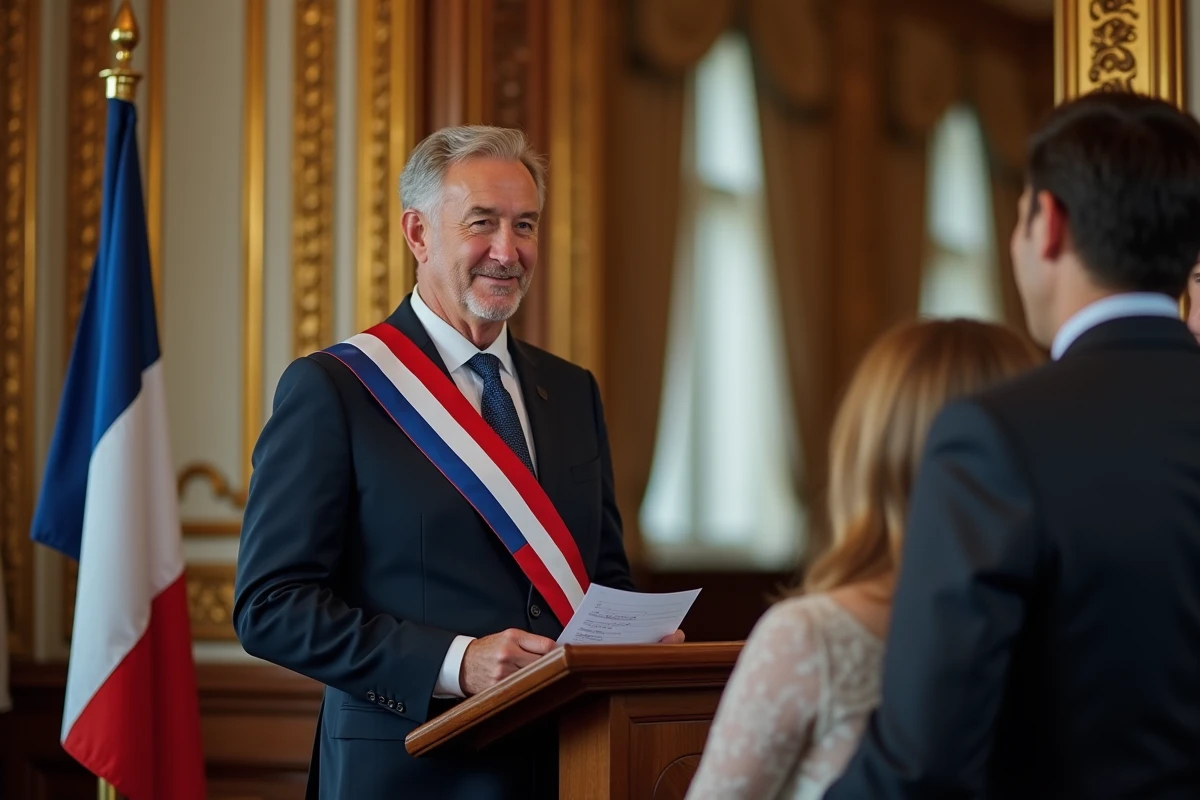
The civil marriage is based on a precise legal framework, but the speech delivered by the mayor (or deputy) provides the only opportunity to add a personal touch to the ceremony. Between the mandatory reading of articles from the Civil Code and the declaration of union, this brief address can transform an administrative formality into a moment of shared emotion. It is essential to know how to prepare it, what it can contain, and where its limits lie.
The preparatory meeting, an unknown step in the mayor’s speech for a wedding
Several town halls have established a preparatory meeting between the elected official and the future spouses, prior to the ceremony. The goal is simple: to gather two or three factual elements about the couple’s story (date of meeting, founding anecdote, common project) to incorporate into the speech on the big day.
This practice avoids improvisation and gives the address a narrative dimension that the reading of articles 212, 213, or 215 of the Civil Code cannot offer alone. The Association of Mayors of France has observed an increase in written requests from couples asking for a personalized speech.
A mayor’s speech for a civil wedding gains in accuracy when it relies on facts shared by the spouses rather than generic phrases. The difference between a flat address and a memorable moment often hinges on this preparatory meeting.
In practice, the elected official can ask the couple to respond in writing to a few questions: how did you meet, what character trait do you admire in each other, what project binds you. These answers serve as raw material, not a script.
Mayor’s speech and Civil Code: what is mandatory, what is free
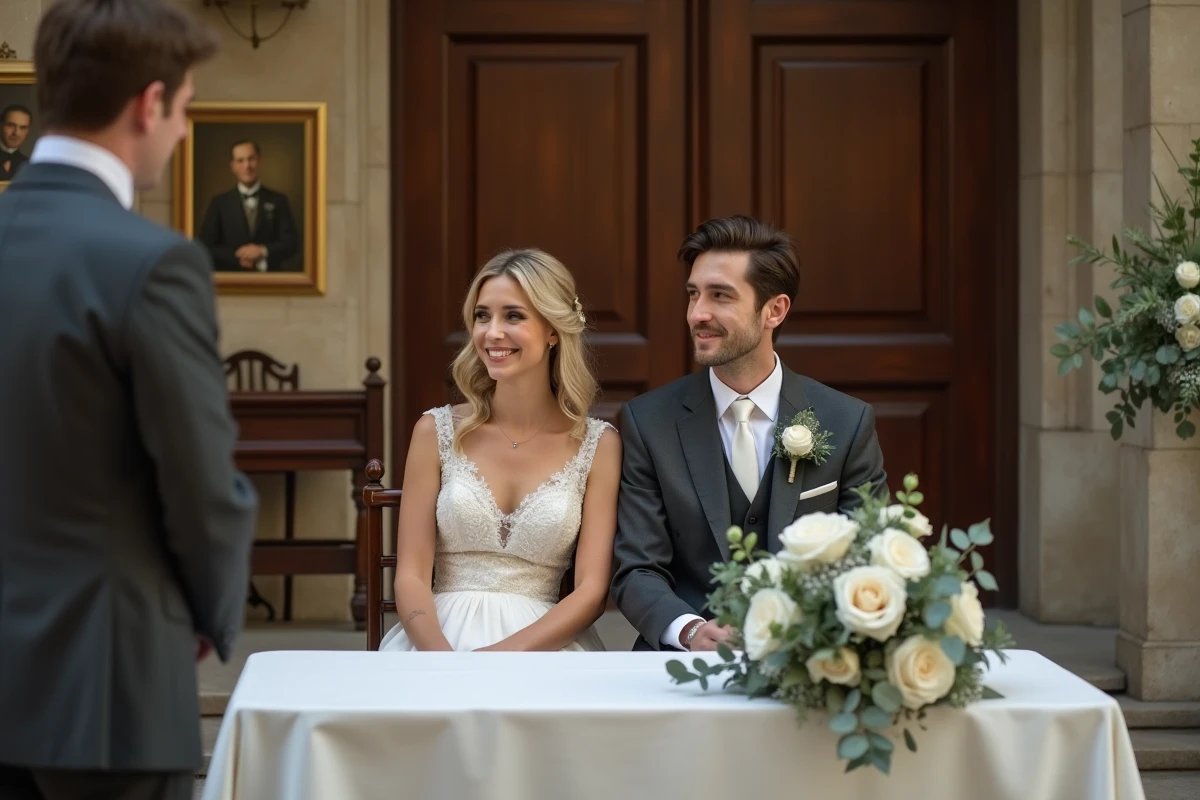
The legal framework requires the reading of several articles from the Civil Code before obtaining consent. Articles 212 (respect, fidelity, support, assistance), 213 (moral and material direction of the family), 214 (contribution to the expenses of marriage), 215 (community of life), and 371-1 (parental authority) form the non-negotiable foundation.
Everything surrounding this reading is at the discretion of the civil status officer. The mayor can add a welcoming word, mention the couple’s journey, quote a literary text, or simply proceed to the consent without further comment. No regulatory text governs the duration or content of the personalized part.
This freedom has a practical limit: the speech should not encroach on the ceremony itself or turn the wedding hall into a podium. Feedback from the field varies on this point, with some elected officials preferring to remain sober while others allow for longer speeches, sometimes resembling a secular ceremony.
Symbolic rituals at the town hall
In recent years, some mayors have agreed to incorporate a symbolic ritual (sand, ribbons, wish box) directly during the civil ceremony. The condition: the ritual remains brief and does not disrupt the legal proceedings. In practice, it takes place just after the exchange of rings, with the prior agreement of the officiant.
This type of addition transforms the speech into a broader sequence, where the mayor’s words are part of a shared staging with the couple and the guests.
Adapting the civil wedding speech to today’s couples
Guides for inclusive language are starting to appear in some municipalities. The goal is to adapt the vocabulary of the speech to same-sex couples, blended families, or intercultural unions. A neutral vocabulary by default avoids assumptions about roles within the couple or about parenthood.
In practice, this involves sometimes minimal but significant adjustments:
- Replacing “husband and wife” with “spouses” or “partners” when the context requires it, to include all couples without needing to rephrase the entire speech.
- Avoiding references to traditional roles (who cooks, who fixes things) that may sound false for many couples, regardless of their composition.
- Mentioning the children already present in the blended family by their first names, if the spouses wish, to ground the speech in the reality of the household.
These adjustments are not a regulatory obligation. They reflect an evolution of local practices, driven by the requests of the couples themselves.
Building a wedding speech that remains memorable
A successful speech relies less on eloquence than on precision. Two or three well-chosen anecdotes leave a stronger impression than a lengthy speech filled with clichéd quotes. The mayor who recounts how the couple met on a train platform creates a memory, whereas a string of abstract wishes is forgotten before leaving the town hall.
The most effective structure follows a simple order:
- A welcoming word to the guests, brief (two sentences are enough), that situates the ceremony and its context.
- The reading of the articles from the Civil Code, without embellishments, to establish the legal foundation of the commitment.
- The personalized part, constructed from the preparatory meeting, with one or two factual anecdotes and a forward-looking passage about the couple’s future.
- The gathering of consent, followed by the declaration of union and the signing of the registers.
The tone benefits from remaining natural. A mayor who reads a text word for word loses emotional impact. An elected official who improvises entirely risks lengthy or awkward moments. The compromise lies between structured notes and freedom of expression on the big day.
The trap of copied-pasted models
Examples of speeches available online serve as a starting point, not a finished product. A speech copied without adaptation always sounds false, because it does not speak to the couple present. Generic phrases (“love is a journey,” “together you are stronger”) work on paper but fall flat when not connected to any concrete fact.
The work of personalization, even minimal, makes all the difference. Replacing a generic quote with the couple’s names and a detail of their story is enough to anchor the speech in reality.
Ultimately, the success of a civil wedding speech hinges on a practical paradox: the legal framework is rigid, but the space left for personal expression is broader than one might think. Town halls that formalize an exchange in advance with couples achieve more accurate ceremonies without unreasonably extending preparation time. The mayor’s speech remains a short exercise, sometimes underestimated, where every sentence counts precisely because there are few of them.